
Should I Be “Buying Austin Real Estate” in 2026?
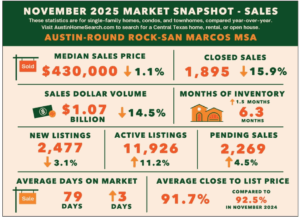
While the national “all-time high” narrative is a broad brush, Austin is a distinct case. In fact, Austin has already undergone a significant correction since its mid-2022 peak—prices are down roughly 18% to 20% from those highs—which is exactly why the outlook for 2026 and 2027 is arguably more stable than it was a year or two ago.
Here is why you should not be worried about real estate depreciating further in Austin through 2026 and 2027.
Please note: “We are agents and investors. We are in the process of buying another investment property at a 5.29% interest rate.”
If you want to know more about how – contact me:
Email: homesatx@gmail.com
Phone: 512-775-5893
What AI is saying about real estate in Austin, TX:
1. The “Correction” Has Already Happened
Unlike many national markets that are just now peaking, Austin has already “taken its medicine.”
Price Rebalancing: The median home price has dropped from the mid-$500k range to approximately $430k–$440k.
A “New Floor”: Most analysts believe we are currently finding the bottom. By 2026, the market is expected to enter a Stabilization Phase, where price growth returns to a normal, healthy 1-3% annually, rather than the double-digit drops of 2023.
2. Robust Economic Fundamentals
Austin isn’t just a “COVID boomtown”; it’s a global tech hub with permanent infrastructure. AI is exploding, driving job growth in the weirdest places – and Austin is reaping the rewards.
Major Employer Commitments: Massive projects like the Samsung chip plant in Taylor and the Tesla Gigafactory are long-term anchors. These companies don’t build $17 billion facilities for a three-year stint; they provide a decade-long floor for job demand.
Low Unemployment: Austin consistently maintains an unemployment rate around 3.4%, significantly lower than the national average. A housing market rarely crashes when people are gainfully employed.
3. Inventory Normalization
One reason prices fell was a sudden surge in inventory as builders caught up.
Supply Tapering: Builders have already begun slowing “starts” (down about 15%). By 2026, the glut of new construction that hit in 2024–2025 will have been largely absorbed.
Housing Underproduction: Long-term, Austin still faces a housing shortage. The Texas Real Estate Research Center notes that household formation is still outpacing unit development over the long arc, meaning the supply-demand imbalance will eventually push prices back up.
4. The “Rate Lock” and Buyer Sidelines
A massive wave of “sideline buyers” is waiting for interest rates to stabilize.
Pending Demand: Many prospective buyers have been priced out by 7% rates. As rates are projected to settle near the 6% mark in 2026, a surge of “pent-up demand” is expected to hit the market.
Refinance Strategy: Investors and buyers are moving from “Wait and See” to “Buy and Refi.” If rates drop further in 2027, the resulting buyer frenzy would likely cause appreciation, not depreciation.
5. Texas-Specific Advantages
No State Income Tax: This continues to be a magnet for high-earning individuals from CA, NY, and IL.
Affordability vs. Coastal Hubs: Even after the boom, Austin remains significantly cheaper than San Francisco, Seattle, or New York, maintaining its status as a “value” destination for tech talent.
Comparison of Market Phases
Period Market Status Action
2021–2022 Hyper-Inflation Unsustainable growth; “The Peak”
2023–2025 Correction / Reset Prices dropped 18-20%
2026–2027 Stabilization Market finds its floor; steady 1-4% growth
Bottom Line: In 2026 and 2027, you aren’t buying into a bubble; you are buying into the “New Normal” after a major correction. The risk of a “crash” is highest when prices are at an irrational peak—but in Austin, that peak was three years ago.
Leave a Reply